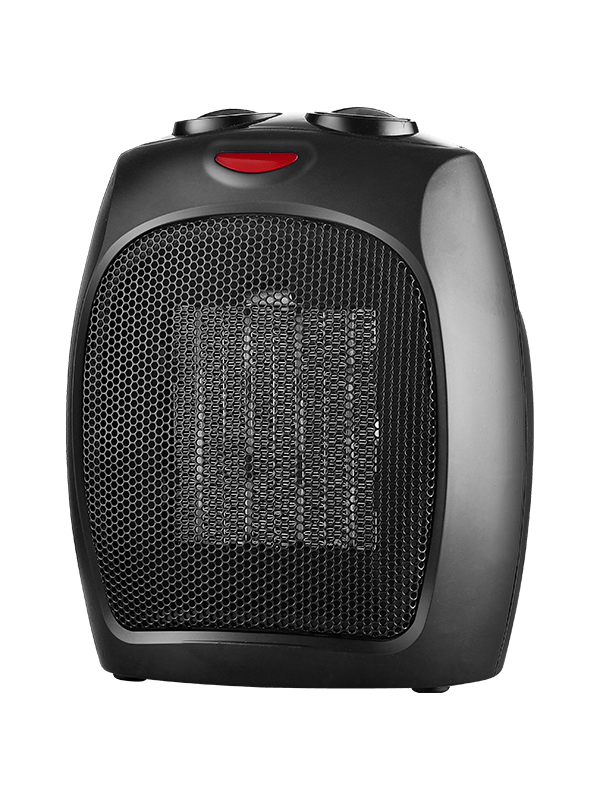
Cixi BEILIGE Electric Appliance Co., Ltd. has manufactured electric heaters in Cixi, Zhejiang, China since 1981. Our Ceramic Constant Temperature Heater manufacturer programme covers PTC ceramic heating appliances for residential, hospitality, office and bathroom projects, with wall-mounted, portable, floor-standing and desktop formats built on shared heating and control platforms.
The factory runs 20 assembly lines across 50,000 m² with a yearly capacity of 6,000,000 units, supported by 31–40 QC staff and a 5–10 person R&D team. More than 20 years of export work has placed BLG heaters in Europe, North America, Japan and other markets, with CE, CB, GS, EMC and BSCI certification held for the relevant models.
Since 198150,000 m² factory20 assembly lines6,000,000 units / yearCE · CB · GS · EMC · BSCI
How the Ceramic Element Holds a Constant Temperature
Every heater in the range is built around a positive temperature coefficient ceramic element. Resistance climbs as the element heats, so current falls back automatically near the designed working temperature instead of running unchecked the way a bare resistance coil does.
That self-limiting behaviour gives the constant-temperature character our buyers specify: fast warm-up at switch-on, a stable output once the element reaches its working point, and no glowing wire inside the air path. A thermostat or electronic sensor then cycles the appliance to hold the room at the set value.
- PTC ceramic blocks resist oxidation and hold their electrical characteristics through long operating cycles.
- Output tapers with element temperature, which reduces the risk of local overheating in the heater body.
- Forced-convection fan models move that heat into the room faster than natural circulation alone.
Ceramic Constant Temperature Heater Range and Application Fit
Six product families share the same ceramic heating and control platform, so a single project can combine formats while keeping one control logic, one safety architecture and one spare-parts list.
| Product range |
Models listed |
Typical build and ratings |
Where it fits |
| Wall Mounted Heater |
33 |
BPT-2000B chassis; 1000 W / 2000 W; one-touch start; 7.5 h or 24 h timer; weekly timer on ERP variants; LED display; remote control; window-open detection |
Living rooms, bedrooms, hotel rooms, offices and apartments where floor area stays clear |
| Portable PTC Heater |
57 |
HPC-D and HPC-F bodies; 750 W / 1500 W and 1000 W / 2000 W; cool, warm and hot modes; adjustable thermostat; oscillation; DC motor; tip-over protection; flame-effect fronts |
Bedrooms, studies, small offices, guest rooms and seasonal retail where fixed wiring is not available |
| Fan Heater |
3 |
FH24/FH24-2, FH09YL, HFN-2021; 1000 W / 2000 W; three heat settings; three-side air outlet; simulated 3D flame; waterproof freestanding housing |
Fast warm-up in utility rooms and lounges, with a visible flame feature for hospitality settings |
| Bathroom Fan Heater |
8 |
Wall and ceiling bathroom formats; bathroom-specific housing and connection arrangement |
Bathrooms and wet rooms, installed to the zone rules that apply in the destination market |
| Tower Fan |
18 |
Tall vertical body with a small floor footprint; oscillating airflow |
Living rooms, offices and reception areas where floor space is tight |
| Table Fan |
3 |
Compact desk and countertop format; heating function fixed per model |
Desks, counters and personal zones needing directed local airflow |
Choosing the Format for the Room and the Installation
Format selection follows the mounting surface, the occupied area and who uses the controls. We size the element and airflow to the heat load of the room rather than to the floor area alone, then confirm the housing that matches the installation.
- Wall-mounted: keeps the heater above furniture and out of the walkway, and suits hotel rooms, apartments and offices where a fixed point of control is wanted.
- Portable PTC: moved between rooms; oscillation and a DC motor allow quieter operation in bedrooms and guest rooms.
- Fan heater: high airflow for quick warm-up, with three-side outlet and flame-effect options for visible retail and hospitality displays.
- Bathroom and tower: bathroom models are fixed against the wet-room zone rules; tower models trade footprint for vertical airflow in tight rooms.
For bathrooms we fix the model, mounting height and cable entry before production, because the permissible position depends on the zone rules of the destination country and on the room layout.
Element, Housing and the Safety Chain
Ceramic blocks are selected for high-temperature resistance and oxidation stability so the element does not drift or degrade in long running hours. Housings, grilles and internal barriers use flame-retardant grades, produced on our own injection-moulding and punching equipment.
- Temperature sensor monitoring the element and cutting power at the set limit.
- Fuse-type thermal protector, plus capillary thermostat and bimetal switch on models that use them.
- Tip-over power cut-off on portable models and child lock on electronic control versions.
- Window-open detection on the smart wall-mounted models, which reduces output when a window is opened.
Controls, Electrical Configuration and Line Integration
The control platform is shared across the range: one-touch start, two heating powers, cool/warm/hot selection, adjustable thermostat, LED display, remote handset, oscillation and timer programming. Model suffixes mark the configuration inside a single housing, so a project can standardise on one chassis and still choose a 7.5-hour timer for the base version or a 24-hour and weekly timer on the L and ERP variants.
We fix rated voltage, frequency, plug type, cord set, rating-label language and carton text for the destination market in the order confirmation, so the electrical interface matches what the installer will find on site.
Control-panel graphics, button legends and display language are produced per order, which allows distributors to carry one heater platform across several markets.
Installation and Commissioning on Site
Wall-mounted units go onto load-bearing walls, not hollow brick or lightweight partitions. Our installation guidance specifies expansion bolts of at least 8 mm diameter with at least 80 mm embedment in the wall excluding the insulation layer, set with a spirit level so the housing sits horizontal.
Clearance around the air inlet and outlet, distance from water sources and flammable materials, and a correctly rated circuit all belong to the installation plan. Commissioning checks cover each heat stage, thermostat hold, timer and weekly programme, oscillation, tip-over cut-off and the remote handset.
Quality Control, Acceptance and Warranty
Our QC sequence runs from supplier selection and evaluation through certified product testing, incoming component control, process monitoring, product inspection and routine test on the line. The in-house testing laboratory and inspection equipment support that sequence, with 31–40 QC staff covering 20 assembly lines.
Certificate documentation for CE, CB, GS, EMC and BSCI is issued with orders where the model and destination market require it, alongside the model test record and inspection paperwork agreed at order stage.
Warranty, spare parts and serviceability
Heaters carry a one-year product warranty, and each order includes a 1% free spare-parts allowance. Service access to the thermostat, thermal cut-out, control board, switch gear and fan motor is designed into the housing so repairs do not require replacing the whole appliance. Routine maintenance is limited to cleaning the intake and outlet grilles, checking the cord set and confirming the thermostat holds its setting.
OEM, Private Label and Custom Development
Our R&D team develops and produces models from customer drawings or samples. In-house injection moulding, punching and paint spray capacity allow housing colour, grille pattern, control-panel graphics, flame-effect fronts and packaging to be adapted without moving the heating platform.
Typical customisation covers power rating and plug standard, timer and remote functions, logo placement, retail carton artwork, instruction manual language and pallet configuration for the destination warehouse.
Information We Use to Configure Your Solution
A workable proposal starts from the room, the wall and the supply. These are the inputs we ask for when a project moves from range selection to a fixed configuration and quotation.
- Room data: floor area, ceiling height, insulation, glazing, target temperature rise and air-change conditions.
- Mounting: wall construction and finish, mounting height, available depth and cable route or socket position.
- Electrical supply: voltage, frequency, circuit rating, plug or socket standard and isolator location.
- Control requirement: mechanical or electronic thermostat, timer length, weekly programme, remote handset, window-open detection, child lock.
- Environment: bathroom zone, humidity, dust level and whether the heater is exposed to public or supervised use.
- Compliance and labelling: certification route, rating-label language, manual language and carton markings.
- Commercial scope: model mix, quantity per variant, packaging format, sample requirement and shipment schedule.
Frequently Asked Questions
What makes a ceramic heater hold a constant temperature?
The PTC ceramic element raises its resistance as it warms, so its power input falls back near the designed working point instead of climbing. The thermostat or electronic sensor then cycles the appliance to hold the room at the selected value, which keeps output stable and removes the glowing coil found in wire-element heaters.
Which power ratings can be ordered?
Our portable PTC and wall-mounted families are built around 750 W / 1500 W and 1000 W / 2000 W elements, with two selectable heat stages on most models. The exact rating for each configuration is stated on the rating label and confirmed on the order.
Can you develop a heater to our drawing or sample?
Yes. Our R&D team works from customer drawings or physical samples, and in-house moulding, metal forming and painting support housing changes, control-panel layouts and packaging design for private-label programmes.
How are bathroom heaters specified?
Bathroom models are fixed by installation zone. We confirm the model, mounting height, cable entry and switching arrangement against the zone rules of the destination country before production, because those rules determine where the appliance may be placed in the room.
What certification and warranty apply to BLG heaters?
The relevant models hold CE, CB, GS, EMC and BSCI certification, with documentation issued alongside orders where the market requires it. Each heater carries a one-year product warranty and a 1% free spare-parts allowance per order.

 en
 English
 中文简体
 Español
 عربى
 русский