 en
en  English
 中文简体
中文简体 Español
 عربى
عربى русский
News
Home / News / Industry News / How Does an Electric Heater Thermostat Work? A Maker's Guide to Heat Control
We are a professional heater supplier.
Content
A thermostat is the quiet decision-maker inside every electric heater. It produces no warmth of its own, yet without it a heater would either run continuously or never start at the right moment. Understanding how this small control component works explains a great deal about why a heater feels steady, why it clicks, and why a room sometimes drifts past the number on the dial.
After more than four decades of building electric heaters for buyers across Europe, the Americas and Japan, we have watched the same questions come up again and again from customers, distributors and end users. The answers are simpler than most people expect.
A thermostat is a controlled switch. It measures the temperature around it, compares that reading with the set point you have chosen, and then opens or closes the electrical path to the heating element.
When the measured temperature drops below the set point, the thermostat closes the circuit and the element receives power. Engineers call this a call for heat. When the temperature climbs back above the target, the circuit opens and heating stops. The fan may keep turning, but the element sits idle.
That cycle repeats for as long as the unit is powered on. A heater thermostat is not a dimmer and does not usually reduce power gradually. It simply interrupts and restores the current, and the thermal mass of the element plus the volume of air in the room smooths those interruptions into something comfortable.
Whatever the price or the styling, every heater thermostat performs the same three steps in the same order.
Mechanical thermostats rely on a bimetallic strip, two metals with different expansion rates bonded together. As the air warms, the strip curls and pushes an electrical contact apart; as the air cools, the strip straightens and the contact closes again. Older designs sometimes use a sealed capillary bulb filled with liquid or gas. The fluid expands into a bellows and moves the contact, which is why many oil-filled radiators and water heaters still use this approach.
Electronic thermostats use a thermistor, normally an NTC type whose resistance falls as temperature rises. A small microcontroller reads that changing resistance through a voltage divider and converts it into a temperature value. Because nothing moves inside the sensor, electronic sensing is faster and far more consistent over time.
In a mechanical unit the comparison is built into the hardware. The dial rotates a cam that changes how far the bimetallic strip must travel before the contacts separate, so turning the dial literally changes the switching temperature.
In an electronic unit the microcontroller runs a short piece of logic: is the measured value below the target? The answer determines whether the output stays high or drops low.
Heating elements draw serious current. A 2000 W heater pulls roughly 8.7 A at 230 V, and a bimetallic contact can carry that directly, which is a large part of why mechanical thermostats remain so inexpensive. The downside is that the contacts arc slightly every time they open, so they gradually wear.
Electronic controls keep mains current away from the sensor. The microcontroller drives a relay or a triac, and the relay is the component you hear clicking. Better designs add a short delay before re-energising the element, which extends relay life and prevents rapid short cycling.
Both families are still in production because they suit different products and price points. The table below summarises where the two approaches diverge.
| Feature | Mechanical thermostat | Electronic thermostat |
|---|---|---|
| Sensing element | Bimetallic strip or capillary bulb | NTC thermistor or digital sensor |
| Typical accuracy | Plus or minus 2 to 3 degrees C | Plus or minus 0.5 to 1 degree C |
| Switching device | Contacts carrying the full load current | Relay or triac driven by a microcontroller |
| Display, timer, remote | Not available | Standard on most current models |
| Main wear point | Moving contacts | Relay contacts, where a relay is used |
| Typical applications | Basic fan heaters, oil-filled radiators | PTC fan heaters, wall-mounted and tower heaters |
A heater does not cut off the instant it reaches the set point and restart the instant it falls below it. There is always a band, usually one to three degrees, between the switch-off point and the switch-on point. This is called hysteresis, or the deadband, and it is entirely deliberate.
Without that band, contacts and relays would chatter on and off dozens of times an hour and fail within a season. A small temperature swing is the price of a long service life, and it is the reason a well-designed heater feels calm rather than twitchy.
Sensor placement matters just as much as the electronics. Most heaters position the sensor near the air intake so it reads the air being drawn in rather than air already blown out. If the unit sits in a draught from a doorway, beside a radiator or in direct sunlight, the reading no longer represents the room and the thermostat will either overshoot or fall short of the target.
Many modern heaters use PTC ceramic elements instead of bare resistance wire. A PTC element's resistance rises sharply once it passes a specific temperature, which naturally limits both how hot the surface becomes and how much current it draws. The element and the thermostat are therefore working as a team: the PTC material caps the surface temperature, while the thermostat decides when the whole unit should stop drawing power.
The practical result is a heater that holds a more stable output, runs cooler at the grille and behaves more gently if the airflow is partly blocked. If you would like to go deeper into the material side, our article on how a PTC heater works covers it step by step.
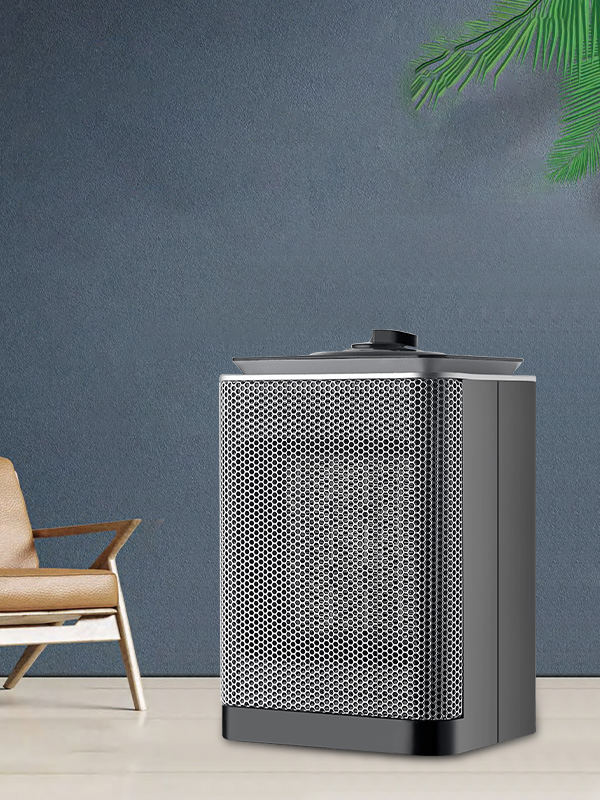 HPC-D1504YL Portable PTC Heater with Adjustable Thermostat and OscillationThis portable PTC heater offers 750W and 1500W settings, cool or warm air, a quiet DC motor, and oscillation. It illustrates how a ceramic element with thermostat control maintains stable output, fitting the article's discussion on stable heating performance.View Product →
Portable PTC heaters with an adjustable thermostat and oscillating airflow, such as the units in our portable PTC range, show this combination clearly: the ceramic element maintains a stable core temperature while the electronic thermostat handles the room-level decision.
Here is a distinction that catches many people out. The adjustable dial or touch panel is the control thermostat. It is not a safety device.
Behind it sit at least two independent protections that operate on a different principle entirely:
This is why a heater that has tripped its thermal fuse must be serviced rather than simply reset. The thermostat may be perfectly healthy while the safety layer has already done its job.
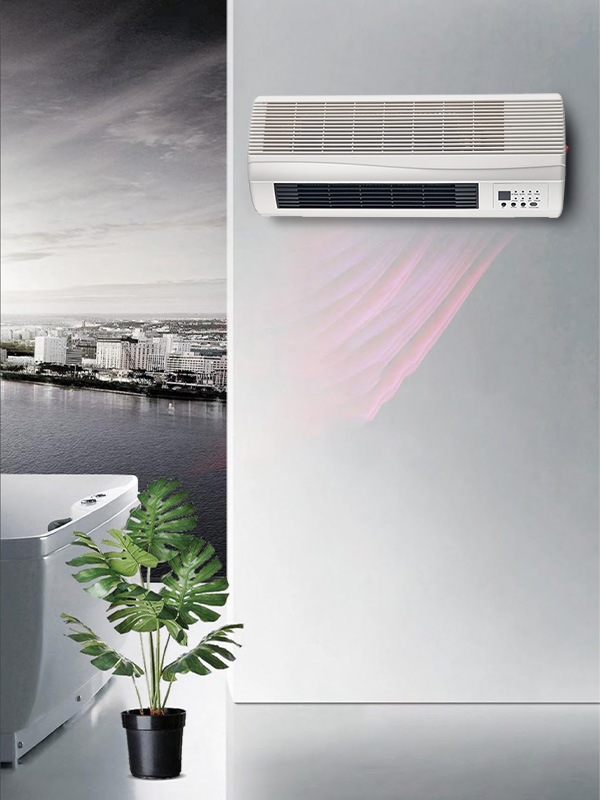
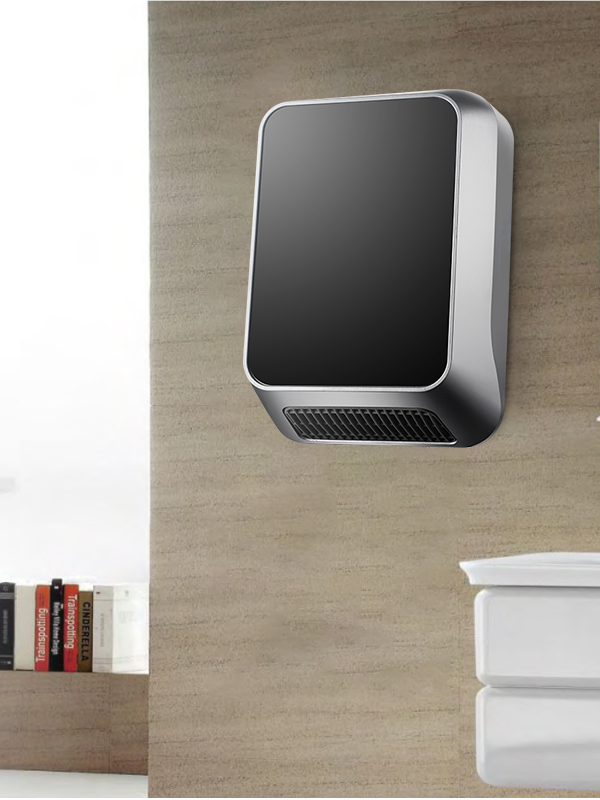 HBH-2007 Wall-Mounted Bathroom Heater with Timer and Touch ScreenA 2000W bathroom heater with LED touch control, adjustable 15–45°C temperature, timer, and overheat protection. It demonstrates the engineering around thermostats in moist environments, as the article notes the need for sealed sensors and safety layers near showers.View Product →
Bathroom heaters are a good example of how much engineering surrounds one thermostat. A wall-mounted bathroom unit has to combine an electronic control, a sealed sensor path, a timer and a moisture-resistant housing before it is allowed anywhere near a shower.
Most complaints about heater thermostats turn out to be placement or expectation issues rather than faults. These habits make a measurable difference:
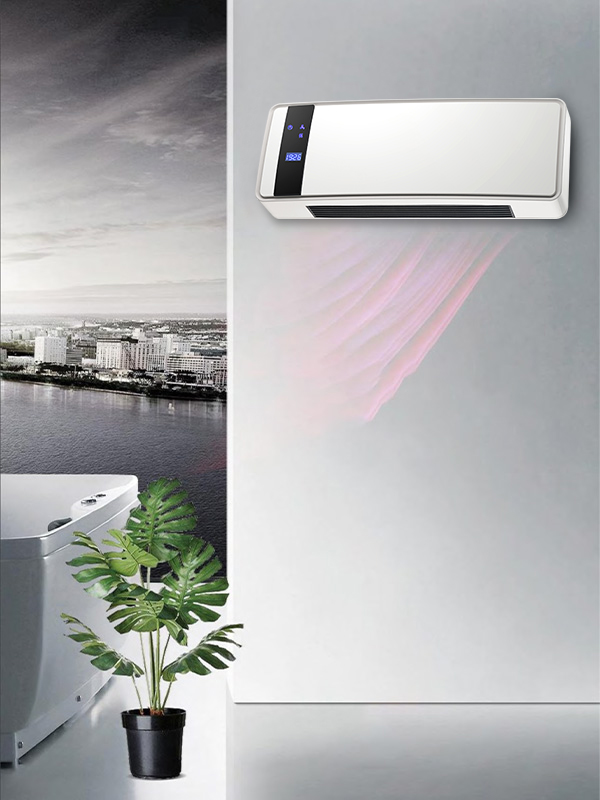 BPT-2000B Wall-Mounted PTC Ceramic Heater with 1000W/2000W PowerThis fixed wall-mounted PTC heater provides selectable fan, warm, or hot air, with child lock and oscillating louvres. Its design places the sensor in the natural convection path, reflecting the article's point on optimal thermostat placement for stable room temperature.View Product →
Fixed installations benefit most from good sensor placement. Wall-mounted PTC ceramic heaters, including our 1000 W to 2000 W models, are designed so the sensing point sits in the natural convection path of the room rather than in the warm exhaust stream.
Thermostat behaviour is one of the areas we test most heavily, and for good reason. A heater's reputation rests on whether it holds temperature consistently after five hundred cycles, not just on the first afternoon.
On our production lines, control assemblies are checked for switching accuracy at several temperature points, relay and contact endurance under repeated cycling, response time after a cold start, and consistent cut-out behaviour at the upper safety limit. Every finished unit is then routine-tested before packing, and the international approvals we hold, including CE, CB, GS and EMC, set the minimum standard that our own process has to exceed.
That infrastructure is also what allows us to support custom development. If your market needs a different set point range, a different hysteresis band, a modified timer sequence or a sensor relocated for a specific enclosure, we can engineer it into the platform rather than bolting it on afterwards.
If you would like to know more about how we work with brand owners and importers, you can read more about our factory and engineering team. The thermostat is a small part of a heater, but it is the part that decides whether the product feels trustworthy every single winter.
Your email address will not be published. Required fields are marked *
Copyright © Cixi BEILIGE Electric appliance Co.,Ltd. All Rights Reserved