 en
en  English
 中文简体
中文简体 Español
 عربى
عربى русский
News
Home / News / Industry News / How Wall Heaters Work: Wall-Mounted PTC vs Fan Heater Technology Guide
We are a professional heater supplier.
Content
For a wall-mounted fan heater, the gap between switching it on and feeling warm air is measured in seconds. That speed is what most people notice first, but the mechanism behind it is simpler than the housing suggests. Every wall heater works on the same principle: draw cool air in, pass it over a hot element, and release the warmed air back into the room. The differences that matter for safety, running cost, and comfort come down to the heating element type and how the air is moved.
Because a wall heater stays fixed in one spot, its job differs from that of a portable space heater. A portable unit follows you from desk to bedroom; a wall heater is expected to hold an entire room at a comfortable temperature. That expectation influences element design, airflow, and the safety systems inside, and the technology has matured enough that a well-chosen unit can warm a bedroom, bathroom, or office quietly and evenly.
A wall heater is a fixed electric appliance mounted on, or recessed into, a wall. It is not a portable floor heater, and it is not a baseboard unit. A wall-mounted heater is installed at a chosen height, connected to the power supply, and left in place to serve one room for years. Wall-mounting keeps the floor clear, places the warm airflow where people actually sit or sleep, and removes the risk of tripping over a trailing cord.
Within the wall-mounted category, two sub-types dominate:
The one-sentence answer is this: a wall-mounted fan heater draws cool air from the room, passes it over an electrically heated element, and forces the warm air back out through the front grille. The cycle repeats until the thermostat senses that the room has reached the set temperature.
Four components do the work: a heating element (metal-sheath wire or PTC ceramic), a fan motor with an impeller, an intake grille at the rear or bottom, and an outlet grille at the front. A control board with a temperature sensor keeps everything in balance. When you switch the unit on, the element heats almost instantly and the fan starts within a second or two. Cold air enters at the lower rear, crosses the element, and exits as a warm stream.
Because the outlet is usually angled upward, the warm air rises after leaving the unit, cooler air returns from floor level, and a convection loop develops across the room. That loop is what lets a 1,500–2,000W unit heat an entire space rather than just the wall it is mounted on.
Not every fan heater uses the same element. A wire element glows during operation and produces heat in an on/off pattern; a PTC ceramic element adjusts its own output and never glows red. For a wall-mounted unit near people and furniture, the PTC type is the safer and more consistent choice. A representative example is the ZPT2000B 1000W–2000W 3-in-1 wall-mounted fan heater, which pairs ceramic heating with fan-forced delivery.
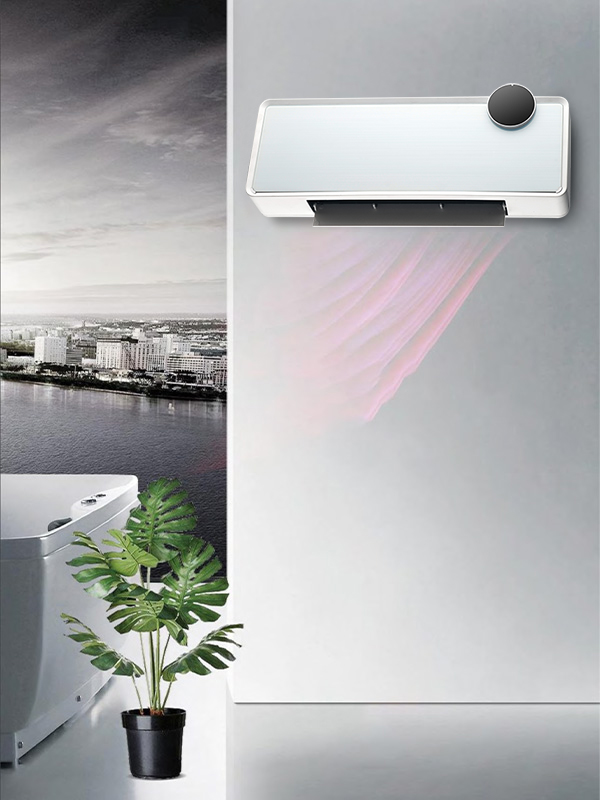 Custom ZPT-2000B 5409L-ERP 1000W/2000W 3-in-1 wall mounted fan heater Suppliers,Cixi BEILIGE Electric Appliance Co., Ltd is China ZPT-2000B 5409L-ERP 1000W/2000W 3-in-1 wall mounted fan heater Suppliers and OEM/ODM Fa...View Product →
The most important advance in wall heaters over the past decade has nothing to do with wattage. It is the positive temperature coefficient element, and its defining trait is that the element itself acts as a safety device.
PTC stands for positive temperature coefficient. The ceramic heating stones are engineered so that their electrical resistance rises sharply as temperature rises. When the element is cold, it passes current easily and heats fast. As it warms up, resistance climbs and the current drops on its own. The element therefore settles at a design temperature and never reaches the glowing red state that bare wire elements reach. This self-limiting behavior is physical, not electronic, so it still works even if a thermostat fails.
That trait matters more on a wall-mounted unit, because it stays near beds, curtains, and children. It also improves efficiency: as the room approaches the set temperature, the element draws less power, avoiding the harsh on/off cycling of older fan heaters. The core advantage remains the same — steady heat without a burn or fire hazard.
For a closer look at the physics, this guide to what PTC heater means in wall-mounted models explains the temperature-resistance curve and why it matters in daily use.
A practical example is the 1000W–2000W wall-mounted PTC ceramic heater from the BPT2000B series, which pairs a self-regulating ceramic core with forced-air output in a slim, wall-hugging housing.
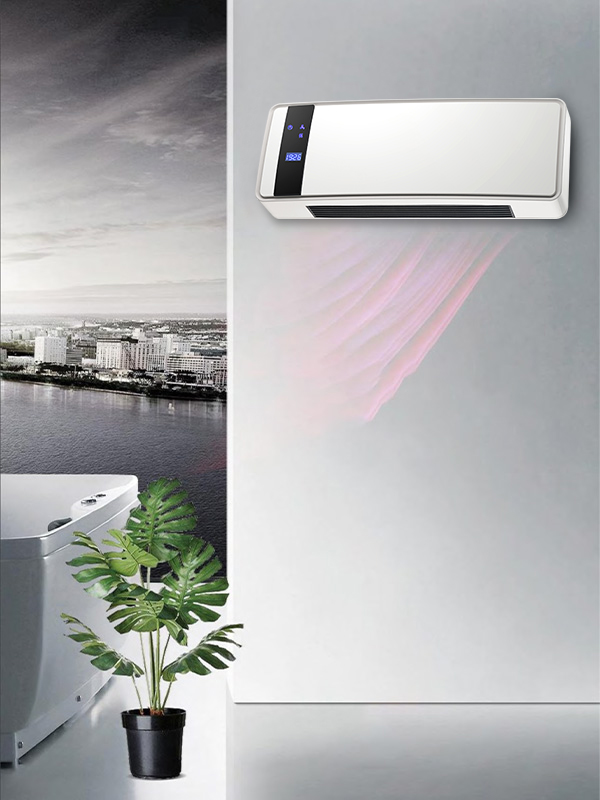 Wall Mounted Ceramic Heater Manufacturers, SuppliersCixi BEILIGE Electric Appliance Co., Ltd. is China Wall Mounted Ceramic Heater Manufacturers and Suppliers, offer Custom Wall Mounted PTC...View Product →
Once the element is understood, the next question is how the heat travels. Fan-forced units push air over the element; convection panels rely on the natural tendency of hot air to rise. The difference shows up in warm-up speed, noise, and suitability for different rooms.
| Delivery type | How heat moves | Warm-up speed | Noise level | Best suited to |
|---|---|---|---|---|
| Fan-forced (wire or PTC) | Fan blows air over the element into the room | Fast; noticeable warmth in 1–3 minutes | Low to moderate fan hum | Bedrooms, living rooms, offices |
| Natural convection | Hot air rises from the panel surface and circulates slowly | Slow; 10–20 minutes to stabilize | Silent | Bathrooms, hallways, small studies |
| Fan + PTC combined | Fan pushes air over a self-regulating ceramic core | Fast | Low hum | General-purpose wall mounting |
For a main living room or bedroom, the combined fan-plus-PTC configuration usually wins, because it delivers fast response without the temperature overshoot of a bare wire element. Natural convection still has a place in a small, well-insulated bathroom, where silence and stable low-level heat are worth more than a quick blast of hot air.
Fixed installation raises the stakes. A wall heater is mounted where children can reach it and where curtains or bedding can stray close, so modern designs share a common set of protective systems.
The safety features incorporated into wall-mounted fan heaters, from thermal cut-outs to enclosure materials, are worth reviewing before you commit to a model.
Installation is not difficult, but it is specific. A wall heater must sit on a surface that can support it, at a height that suits the airflow, and with enough clearance around the intake and outlet.
Our full wall heater installation guide walks through the measuring, fixing, and leveling steps so the job stays predictable.
The most common buying mistake is choosing by price rather than wattage. A 750W unit is fine for a small bathroom, but it will spend most of the day trying to warm a 20 m² living room.
| Room size | Recommended power | Typical use |
|---|---|---|
| Up to 8 m² | 750–1000W | Bathroom, study, entryway |
| 8–15 m² | 1000–1500W | Bedroom, small office |
| 15–25 m² | 1500–2000W | Living room, open-plan kitchen |
| 25 m² and above | 2000W+ or two units | Large open areas, poorly insulated rooms |
Controls separate a heater that merely works from one that is pleasant to live with. A mechanical dial is the cheapest and most reliable option, but it gives coarse temperature control. Digital controls with an LED display allow a precise set temperature, a 1–24 hour timer, and an eco mode that trims power once the room is warm. Remote control adds convenience when the unit is mounted high or in a hard-to-reach position.
For that kind of flexibility, the BPT2000B 5007 series remote-control wall heater lets you adjust the temperature and timer without leaving the sofa, and it includes fast-heating elements for rooms that cool down quickly at night.
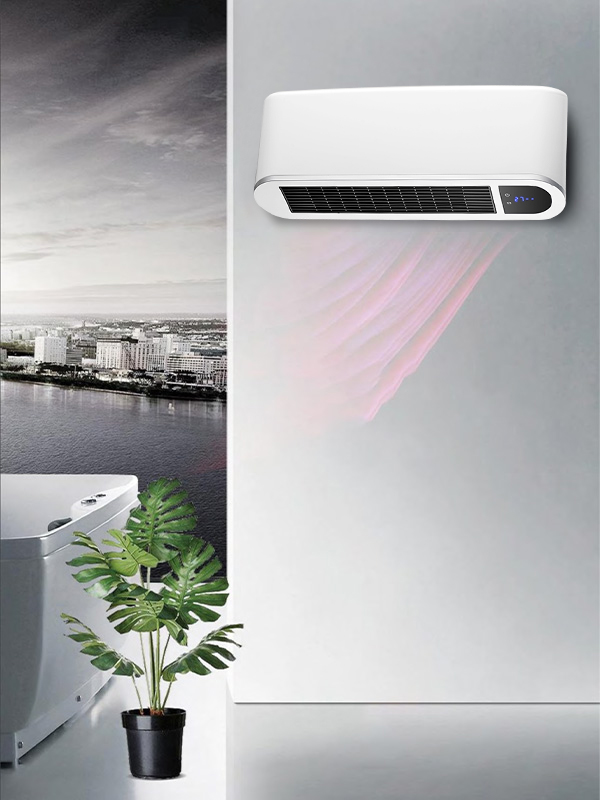 Custom BPT-2000B 5007L/5007L-ERP Fast Heating Electric Remote Control Wall MountCixi BEILIGE Electric Appliance Co., Ltd is China BPT-2000B 5007L/5007L-ERP Fast Heating Electric Remote Control Wall Mounted Heater Supp...View Product →
So how do wall heaters work? In short: they take cool air from the room, pass it over an electric element, and push the warmed air back out. The more useful question is how well they do it. A wall-mounted PTC heater with an integrated fan offers the best balance for most homes — fast warm-up, a self-limiting ceramic element, low noise, and zero floor footprint. Match the wattage to the room, confirm the overheat and water-ingress protection, and mount it at the right height, and a wall heater becomes one of the most dependable heat sources you can install.
Infrared vs. Ceramic Heater: Which Constant Temperature Heater Is Right for You?
2026-08-05Types of Wall Heaters: A Practical Guide to Choosing the Right Wall-Mounted Heater
2026-08-19Your email address will not be published. Required fields are marked *
Copyright © Cixi BEILIGE Electric appliance Co.,Ltd. All Rights Reserved